September 4, 2026
The Internet Has No GPS: How BGP Policy Steers Your Packets
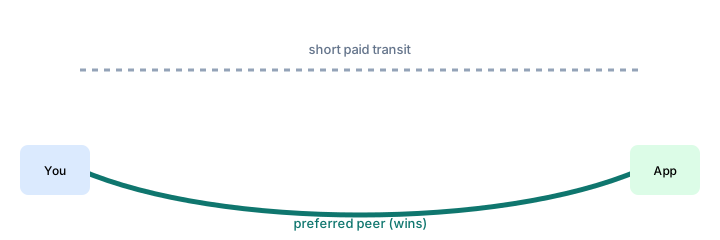
People draw the internet like a subway map. Shortest line wins. That picture is false. BGP is a treaty system. A two-hop path that costs money loses to a six-hop path that is settlement-free. If your video call hairpins through another continent, somebody’s policy did that on purpose — or by accident that looks like purpose.
Policy beats trigonometry
Inside one company, OSPF and IS-IS really do care about cost and delay. Between companies, BGP cares about contracts. The decision stack on most border routers is some flavor of: highest local preference, shortest AS path, lowest origin type, MED, eBGP over iBGP, nearest IGP next hop. Local preference is first. That means a network can stamp “I like this peer” so hard that a path twice as long still wins.
This is why traceroute from two offices on the same campus can diverge at hop three. It is also why “just add a shorter path” as a support ritual fails. You cannot shorter-path your way through someone else’s local-pref.
How to see policy without reading their config
You will never see another network’s route-map. You will see its effects. Paste the destination into BGP Lookup and note the origin ASN and covering prefix. Then open Looking Glass from more than one region.
- Same origin, wildly different AS paths: policy or peering topology, not a down server.
- One region has no path: a community, an RPKI drop, or a filtered peer — not “AWS is offline.”
- A path that suddenly grows repeated ASN tokens: prepend. They are turning the volume down on that link.
Prepend is the internet’s passive-aggressive sticky note. It does not delete the route. It makes the route look longer so fewer networks choose it. Operators use it during maintenance, traffic engineering, and quiet political fights.
Communities are invisible hands
A route can carry tags that mean “do not export to this peer,” “blackhole this /32,” or “keep this inside the continent.” Public looking glasses rarely print those tags cleanly. You infer them when a prefix vanishes from one collector and remains on another while ping from that city still works. The collector is not your user path. Absence on a collector is a clue, not a death certificate.
What this means when an AI app “routes weird”
Large model APIs are anycast or geo-steered. The name you resolve is not a single basement. Policy plus anycast plus a DNS resolver in another country produces the classic ticket: “latency 40 ms from home, 240 ms from the office, same laptop.” That is not the weights. That is two different treaties toward the same prefix. Prove it with traceroute and a looking-glass pair before you resize a GPU cluster.
A field habit
Keep a note of the normal AS path to your five critical prefixes. When users say the internet is possessed, compare. Policy changes leave fingerprints: new transit in the path, a prepend that was not there Tuesday, an origin that moved. RPKI tells you if the new origin is even allowed. Lookup tells you who it is. Looking glass tells you who believes them.
Compare two regions for one prefix on the Looking Glass. If the paths disagree, you found policy. If they agree and the app still fails, you found the app.
FAQ
FAQ
Is a longer AS path always worse?
For the default tie-break, yes. After local preference, no. Many “bad” paths are chosen because they are free or politically safer.
Can I force the short path from home?
Only by changing your upstream or using a tunnel that enters a network with different policy. You cannot vote in someone else’s local-pref election.
Does IPv6 use different policy?
Often. Always look at both families. A network that is surgical on v4 can be sloppy on v6.